Skip to content

Puglia with Kids

Puglia is the heel of Italy: a long, flat, heavily farmed region with around 800 kilometres of coast, whitewashed hill towns and the cone-roofed stone trulli of the Valle d'Itria. What makes it work with children is the masseria — a fortified farmhouse converted into rooms or self-catering apartments, almost always with a pool and space to run — which turns the hottest part of the day into a swim rather than a problem. It is a driving region rather than a walking one, with towns 20 to 40 minutes apart, the best beaches further than that, and a railway that is slow and thin on Sundays. Two things are worth knowing before booking: August is very hot and full of Italian domestic holidaymakers who arrive in the same fortnight and use the same beaches, and much of the Adriatic coast is limestone platform and pebble cove rather than sand — the long shallow beaches are on the Ionian side, in Salento.

Best for ages
3+
Suggested stay
6–10 days
Best months
May–Jun, Sep–Oct
Daily budget
€210

Mid-range, family of four

Why Puglia works with children

  • A pool at the end of every day

    Farmhouse stays are built around a pool and a walled courtyard, which is what makes an inland afternoon in June or September workable.

  • A town of cone-roofed stone houses

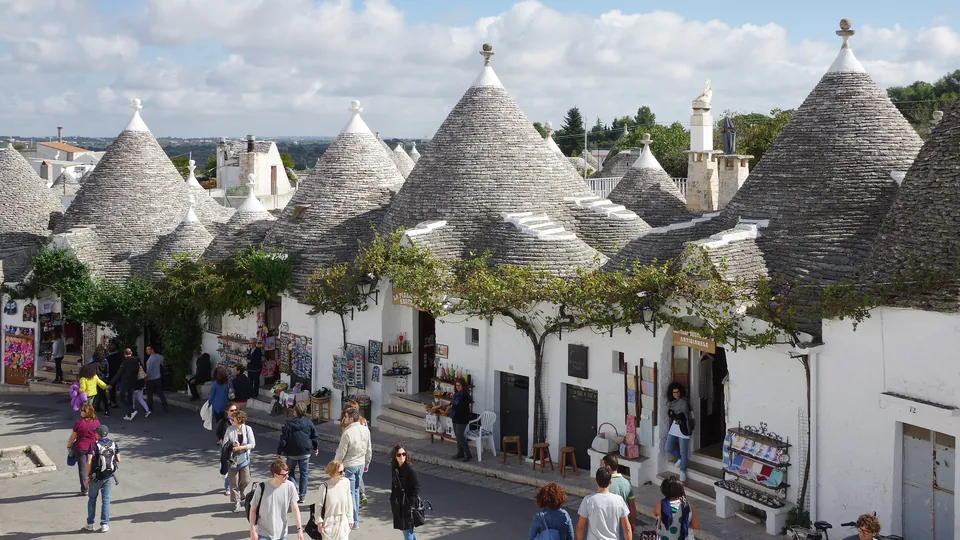
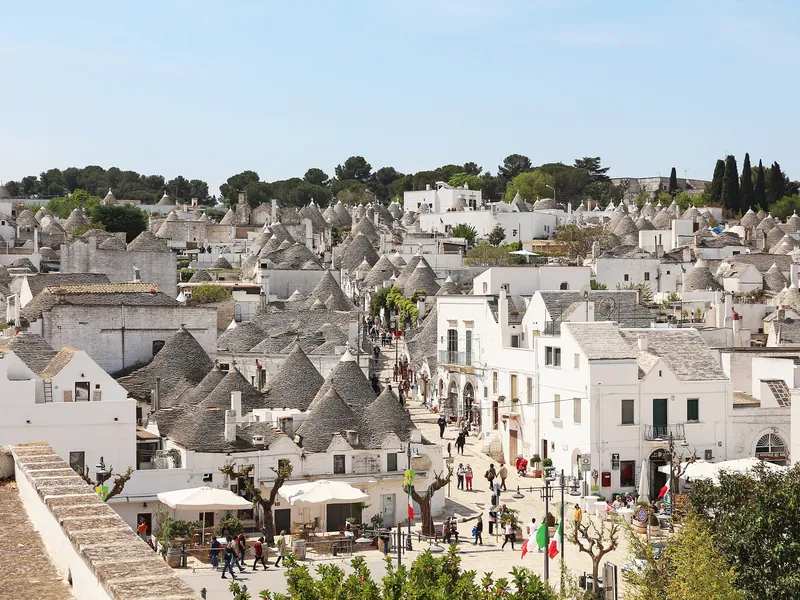
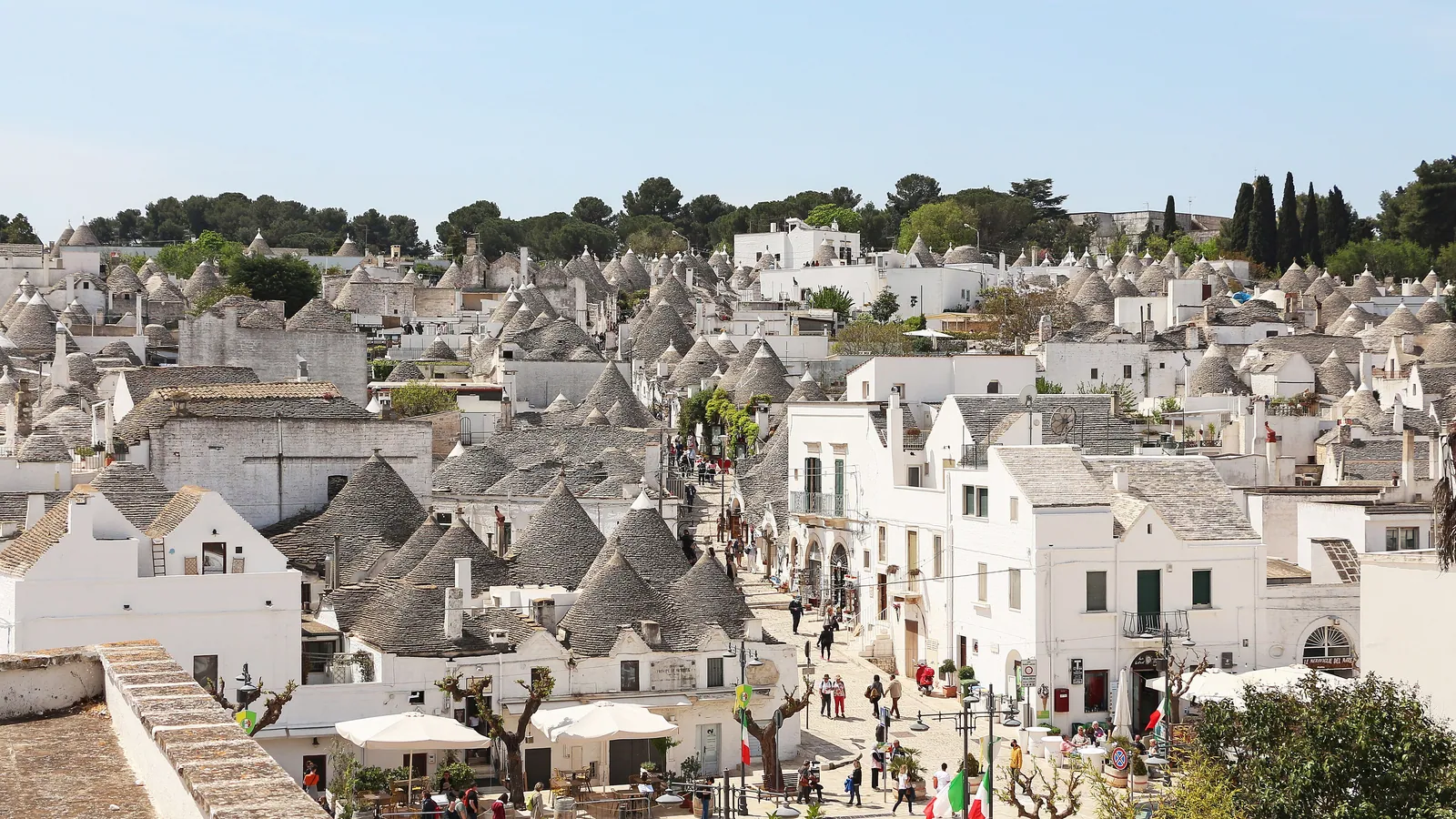
    Alberobello holds more than a thousand dry-stone trulli, walkable in an hour and understood without any explanation.

  • Shallow sand on the Ionian side

    The Salento beaches between Porto Cesareo and Pescoluse shelve very gradually over fine pale sand.

  • Bread, cheese and pasta as the local diet

    Focaccia, orecchiette, mozzarella and almond gelato are everyday food here, which removes the daily menu negotiation.

  • Cheaper than northern Italy

    Farmhouse apartments, restaurants and site entry all cost less than the equivalent in Tuscany or on the lakes.

Where to stay

Best areas in Puglia for families

4 areas cover most trips here; the difference is mainly farmhouse stays and a first visit versus pine forest, cliffs and a quieter coast.
  • Valle d'Itria (Alberobello, Locorotondo, Martina Franca)

    Best for farmhouse stays and a first visit

    Trulli country in the middle of the region, with the densest concentration of converted masserie and hill towns 15 to 30 minutes apart. The coast is a 30 to 40 minute drive in either direction, which is the trade for the countryside and the pool.

  • Adriatic coast (Polignano a Mare, Monopoli, Ostuni)

    Best for towns with a railway and a sea view

    Whitewashed old towns on low cliffs, with a coastal train line and Bari airport within an hour. Swimming here is mostly from rock platforms, ladders and small pebble coves rather than long stretches of sand.

  • Salento, Ionian side (Porto Cesareo, Gallipoli, Pescoluse)

    Best for young children and a beach week

    The flattest, sandiest and shallowest water in the region, with resort-style development behind it. It is the far corner of Puglia, roughly two hours from Bari, and the most crowded part of it in August.

  • Gargano & the north

    Best for pine forest, cliffs and a quieter coast

    A limestone headland with a national park, cliff coves, ferries to the Tremiti islands and a landscape nothing like the flat south. The access roads are winding and it is a long drive from anywhere else in the region.

Family hotel picks in Puglia

  • Masseria with a pool in the Valle d'Itria
    Valle d'Itria (Alberobello, Locorotondo, Martina Franca)Mid-range

    Masseria with a pool in the Valle d'Itria

    A converted farmhouse with a pool is the setup the whole region is built around: grounds to run in, a kitchen or an on-site restaurant, and the trulli towns 15 to 30 minutes away, so a day can be one town and a swim rather than a drive.

    • Pool and grounds for the hottest part of the day
    • Self-catering apartments, or rooms with breakfast made on site
    • Alberobello, Locorotondo, Ostuni and Martina Franca within half an hour
    • Working farms often sell their own oil, cheese and vegetables

    Fitting a family in

    Two-bedroom apartments and family suites sleeping four to six are common, and some masserie let as a whole house, which works for two families travelling together.

    Watch out. Most sit several kilometres down an unlit country lane with nothing walkable nearby, so every evening is either the on-site restaurant or a drive. Pools are often unheated and unfenced, the coast is a 30 to 40 minute drive, mosquitoes are a real nuisance on summer evenings, and July and August are usually sold as Saturday-to-Saturday weeks booked months ahead.
  • Villa or apartment near the Ionian coast
    Porto Cesareo / Torre Lapillo / GallipoliMid-range

    Villa or apartment near the Ionian coast

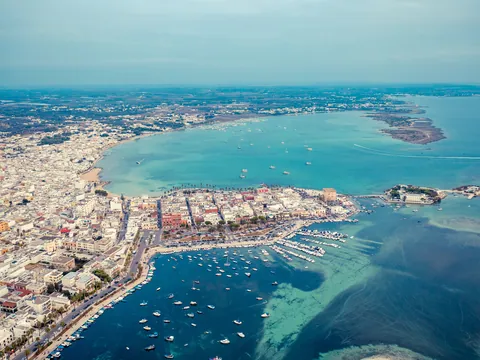
    The long shallow beaches are the reason to come this far south, and a self-catering house within walking distance of one removes the beach car-park problem that defines July and August here.

    • Walking distance to shallow sandy beaches in the better locations
    • Kitchen for the early suppers the Italian dinner hour makes necessary
    • Private or shared pool at many properties
    • Supermarkets and beach kiosks close by in the resort villages

    Fitting a family in

    Two- and three-bedroom holiday houses sleeping four to eight are the standard product, usually with a terrace or a garden and often a second bathroom.

    Watch out. This is the far corner of the region — roughly two hours from Bari airport and an hour and a half from Brindisi — and it is emphatically seasonal, with many properties, restaurants and beach clubs shut from October to May. August books out months ahead at roughly double the June rate, air conditioning is not universal in older houses, and some listings described as near the sea are a ten-minute drive from it.

  • Old-town apartment in Monopoli or Polignano
    Monopoli / Polignano a Mare (Adriatic coast)Mid-range

    Old-town apartment in Monopoli or Polignano

    Staying in a coastal town rather than the countryside puts restaurants, a supermarket and a gelateria within walking distance, with a railway station and Bari airport inside an hour — the practical choice for a family that would rather not drive to dinner.

    • Walkable old town with restaurants and shops at the door
    • Coastal train line to Bari and the other Adriatic towns
    • Small sandy coves in Monopoli, rock platforms elsewhere
    • Kitchen for breakfasts and early suppers

    Fitting a family in

    Converted town houses and apartments sleeping four to six are widely available, frequently arranged over two floors with a roof terrace.

    Watch out. Swimming on this coast is mostly from rock platforms, ladders and small pebble coves rather than long sand, so it suits confident swimmers more than toddlers. Old-town buildings rarely have lifts, the lanes are limited-traffic zones a car cannot reach, and noise carries late on summer nights in a stone alley.

All family stays in Italy

Some links on this page are affiliate links. If you book through one, the price is the same for you and we may earn a commission. How this works.

Things to do in Puglia with kids

  • Alberobello's trulli districts
    Culture

    Alberobello's trulli districts

    Puglia

    Two neighbourhoods of dry-stone houses with conical limestone roofs, more than a thousand of them in total, built without mortar and now protected. Rione Monti is the steep, busy half where most trulli are shops; Aia Piccola across the road is residential and quiet.

    Ages
    3–16
    Time
    2h 30m
    Adult, from
    Free

    Good to know. The lanes are steep, cobbled and stepped, which is hard work with a pushchair, and there is no shade in the middle of the day. Coach groups fill Rione Monti from mid-morning until late afternoon, and almost all of its trulli are now souvenir shops. Walking the districts is free; entering the furnished example trulli and the small museums is not.

  • Polignano a Mare and Lama Monachile
    City

    Polignano a Mare and Lama Monachile

    Puglia

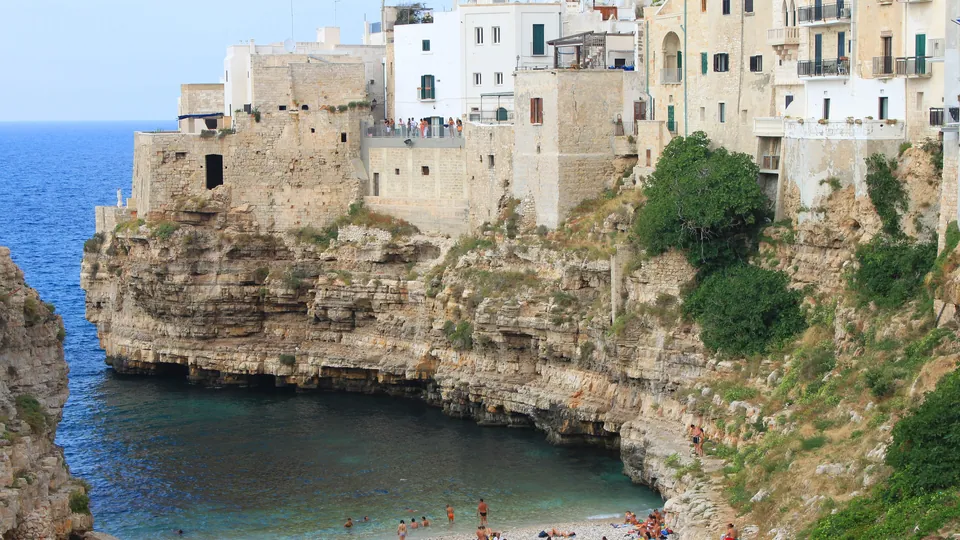
    A white town built along the lip of a limestone cliff, with a small pebble cove — Lama Monachile — wedged at the bottom of a ravine beneath an old bridge, and sea caves along the coast that are visited by boat from the harbour.

    Ages
    5–16
    Time
    3h
    Adult, from
    Free

    Good to know. The cove is small, entirely pebble and reached by a long flight of steps; it is full by mid-morning through the summer and has no shade whatsoever. Several clifftop viewpoints are unfenced, and the town's lanes and car parks are congested from June to September. Cliff diving happens here and is not something to copy.

  • Grotte di Castellana
    NatureBook ahead

    Grotte di Castellana

    Puglia

    A limestone cave system running about three kilometres underground, visited on a guided walk past chambers, stalactites and a white alabaster grotto at the far end, with a shorter one-kilometre route for anyone who does not want the full loop.

    Ages
    5–16
    Time
    2h
    Adult, from
    €18

    Good to know. The visit starts with a descent of roughly 60 metres by steps, with no lift and no pushchair access, and the same climb back at the end. The air holds steady at about 16 to 18 °C all year, so a jumper is needed even in August. Tours leave at fixed times in Italian and English and the summer departures sell out, so a slot is worth securing in advance. Parts of the route are dimly lit, which unsettles some younger children.

  • Clusters of whitewashed cone-roofed stone houses on a hillside
    Water

    The Ionian beaches of Salento

    Puglia

    The stretch of Salento coast from Porto Cesareo and Torre Lapillo down to Pescoluse, where fine pale sand shelves very gradually into calm shallow water. It is the flattest and shallowest swimming in Puglia and the reason families travel to the far south of the region.

    Ages
    0–16
    Time
    5h
    Adult, from
    Free

    Good to know. Private lidos occupy much of the best sand and charge by the day for a sunbed and umbrella; the free stretches between them are narrower, unshaded and taken early. Car parks are small, paid and full by mid-morning in July and August, when the entire coast is on Italian domestic holiday. Afternoon onshore wind is common, and the very shallow water warms quickly but also weeds up in places.

Some links on this page are affiliate links. If you book through one, the price is the same for you and we may earn a commission. How this works.

Getting around Puglia

A car is effectively required. Trains run down the coast from Bari and a separate regional line serves Alberobello and Martina Franca, but services are sparse, slow and much reduced on Sundays, and no train reaches a beach worth the journey. Distances between towns are short and the roads are flat and straightforward, which makes this one of the easier parts of Italy to drive in — the exception is August, when the coast roads and the Salento beach car parks are congested from mid-morning. Every old town is a limited-traffic zone, so park outside the walls and walk in. Bari and Brindisi airports are both used: Brindisi is closer to Salento, Bari closer to the trulli and the Gargano.

Puglia tips for families

  • Money & costs

    Most of the good sand is part-private

    A lido rents a sunbed and umbrella by the day and occupies much of the best beach; the free stretches between them are narrower, unshaded and fill early. Budget for one or two lido days rather than assuming free sand with shade exists.

  • When to go

    August is the domestic holiday month

    Italian families take their holidays in the same two or three weeks, so Salento accommodation books out months ahead, prices roughly double and beach car parks fill before 10:00. June and September have the same sea temperature and a fraction of the traffic.

  • Getting around

    Ask how far the masseria is from a shop

    Many sit several kilometres down an unlit country lane with nothing walkable nearby, so every evening meal is either the on-site restaurant or a drive there and back. That is fine when it is expected and a problem when it is a surprise.

  • Packing

    Pack water shoes for the Adriatic side

    North of Salento the coast is limestone platform and pebble cove, often with a metal ladder into the water rather than a shelving entry. Water shoes are the difference between swimming and standing at the edge.

Puglia with kids: common questions

How many days do you need in Puglia with kids?
Six to ten. A week from a single base in the Valle d'Itria covers the trulli, two or three old towns, the caves and a couple of beach days. Ten days makes Salento reasonable as well, and it is better added as a second base than driven as a day trip.
Do you need a car in Puglia?
Yes. The towns are close together but the trains between them are slow and infrequent, and the beaches have no rail access at all. The roads are flat and easy, so it is one of the less demanding regions of Italy to drive in.
Where are the best family beaches in Puglia?
The Ionian coast of Salento — Porto Cesareo, Torre Lapillo and the Pescoluse stretch — where the sand is fine and the water stays shallow a long way out. The Adriatic side from Polignano to Otranto is mostly rock platform and pebble cove, which suits confident swimmers rather than toddlers.
What is a masseria?
A fortified farmhouse, most of them built between the sixteenth and nineteenth centuries and now converted into rooms or self-catering apartments. Most have a pool, grounds and a restaurant, and they are the standard family accommodation in the Puglian countryside.
When is the best time to visit Puglia?
May, June, September and early October. The sea is warm enough to swim from June through to October, the towns are comfortable to walk, and prices sit well below the August peak. July and August are hot, with inland temperatures over 35 °C and the coast at its busiest.