Asia · 4 destinations
Vietnam with Kids: When to Go, Where to Stay & Costs
Vietnam gives a family an unusual amount for the money: a dense, food-obsessed capital, limestone valleys crossed by rowing boat, a lantern-lit merchant town on the central coast, and island beaches in the far south. Children are made a fuss of almost everywhere, food is cheap and largely mild in the north, and domestic flights are short and inexpensive enough that a 1,700 km country is genuinely coverable in two weeks. The two real difficulties are weather and traffic. Vietnam runs on three different climate calendars, so the month that suits Hanoi may be the month that floods Hội An, and a single national best season does not exist. City traffic is dominated by motorbikes, crossing roads with small children takes a technique rather than a gap, and child car seats are rarely offered in taxis or hired cars.
- Best for ages
- 5+
- Recommended trip length
- 12–16 days
- Budget level
- €
- Best time to visit
- Feb–Apr, Nov–Dec
Suits up to 16
Budget
Why Vietnam works for families
Costs that change what a family can book
Rooms with a pool, private drivers and sit-down meals all land well below the equivalent in Europe, which buys back days rather than luxuries.
Food cautious eaters will actually eat
Noodle soup, rice plates, grilled pork, spring rolls, baguettes and tropical fruit are everywhere; northern cooking serves chilli on the side rather than in the pot.
Limestone karst at ground level
The Ninh Bình valleys deliver the same scenery as the famous bays from a flat-water rowing boat, without a night on a cruise ship.
Old towns small enough to walk
Hội An's heritage quarter is a few hundred metres across, so a cultural day is a short walk rather than a museum circuit.
Internal hops instead of driving days
Hanoi to Đà Nẵng or Đà Nẵng to Phú Quốc is roughly an hour or two in the air and cheap, which is what makes a north-to-south route work in two weeks.
Low crime, but traffic is the real risk
Petty theft in crowded markets is the usual concern; road traffic is the hazard that actually needs managing with children.
Where to go in Vietnam
The areas worth building a family trip around, and how long to give each.
When to visit Vietnam with kids
There is no single best time to visit Vietnam, and treating it as one country with one season is the most expensive planning mistake here. The north (Hanoi, Ninh Bình) is most comfortable from October to December and again in March and April; January and February are cool and drizzly and June to August is hot with heavy rain. The centre (Hội An, Đà Nẵng) is dry from roughly February to August, but September to November is the typhoon and flood season, and the Hội An old town takes river water in some years. The south and Phú Quốc are dry from November to April and wettest from June to September. February to April and November to December are the windows where most of the country works at once, which is why they are listed above.
- Jan
- Feb
- Mar
- Apr
- May
- Jun
- Jul
- Aug
- Sep
- Oct
- Nov
- Dec
Where to stay
Family hotels in Vietnam
We list areas and property types rather than single hotels: family-room availability changes constantly, and the area plus the room requirement is what survives contact with a booking engine.
 Hoàn Kiếm / Old QuarterBudget
Old Quarter — small hotels with family rooms
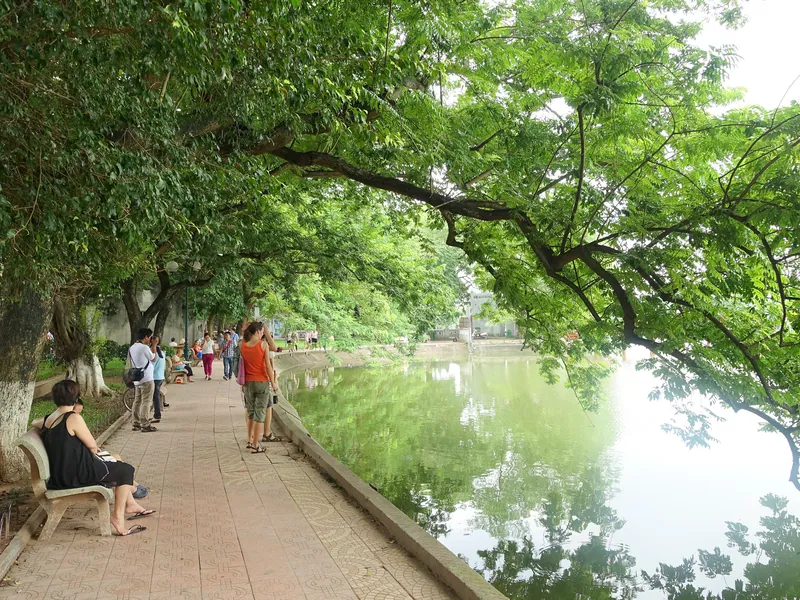
Puts a family within a ten-minute walk of the lake, the puppet theatre and the cheapest food in the city, which matters more than the room does on a two-night stay — nothing needs a taxi and nobody has to cross a major road tired.
- Walking distance to Hoàn Kiếm lake and the weekend walking streets
- Family and triple rooms in small owner-run hotels
- Breakfast included almost as standard
- Street food and pharmacies on every lane
Fitting a family in
Look for rooms sold as family, triple or quad — a fourth bed is usually a genuine bed rather than a sofa. Confirm the stated occupancy rather than assuming, and ask which floor the room is on.
Watch out. Several old-quarter lanes have bars running late, and street-facing rooms hear all of it. Buildings are narrow and tall, and lifts are small or absent, which means carrying suitcases up four or five flights. Ask for an interior room on a low floor.
Check hotel prices — opens Klook in a new tab (affiliate link)Live availability for your dates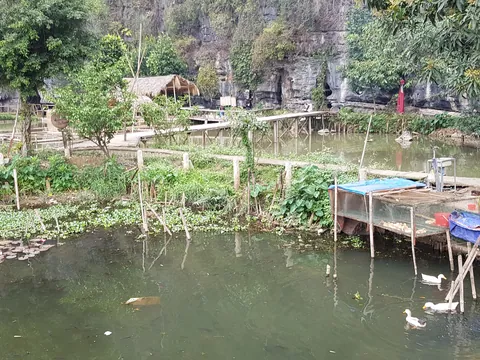 Tam Cốc / Văn LâmBudget
Tam Cốc — bungalow homestays in the rice fields
Puts the boat pier and the flat cycling lanes within walking distance, so a family can do the trip at first light without a driver, and the setting between karst towers and rice fields is the reason to stay overnight at all.
- Walking or cycling distance to the Tam Cốc pier
- Free bicycles at most properties
- Small pools at the larger bungalow complexes
- Family bungalows and multi-bed rooms as standard
Fitting a family in
Bungalows are frequently sold as family units with a double and two singles in one room, which suits four without a rollaway. Air conditioning is worth confirming rather than assuming at the cheapest end.
Watch out. This is a village: there are very few places to eat beyond the guesthouse kitchens, so dinner is wherever the family is sleeping. Bungalows are often thin-walled and arranged around one pool, insects are part of the deal, and the cheapest rooms have little shade.
Check hotel prices — opens Klook in a new tab (affiliate link)Live availability for your dates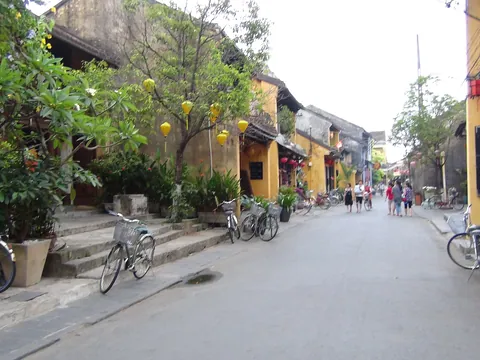 Minh An / old town edgeMid-range
Old town edge — hotels within walking distance
The lanterns come on after dark and the market opens early, and being a few streets back from the heritage core means a family can do both on foot rather than negotiating a shuttle timetable with tired children.
- Five to ten minutes' walk to the heritage core and the river
- Pools at most mid-range properties
- Free bicycles and a beach shuttle
- Tailors, pharmacies and restaurants on the doorstep
Fitting a family in
Family rooms with two double beds are widely available and are usually the cheapest way to sleep four here. Garden-wing rooms are quieter than street-facing ones for a small difference in price.
Watch out. Evening noise carries from the bars on the river's south bank, and the streets nearest the water are the ones that flood in the September to November season — ask which floor the room is on and what the property's policy is if the river rises.
Check hotel prices — opens Klook in a new tab (affiliate link)Live availability for your dates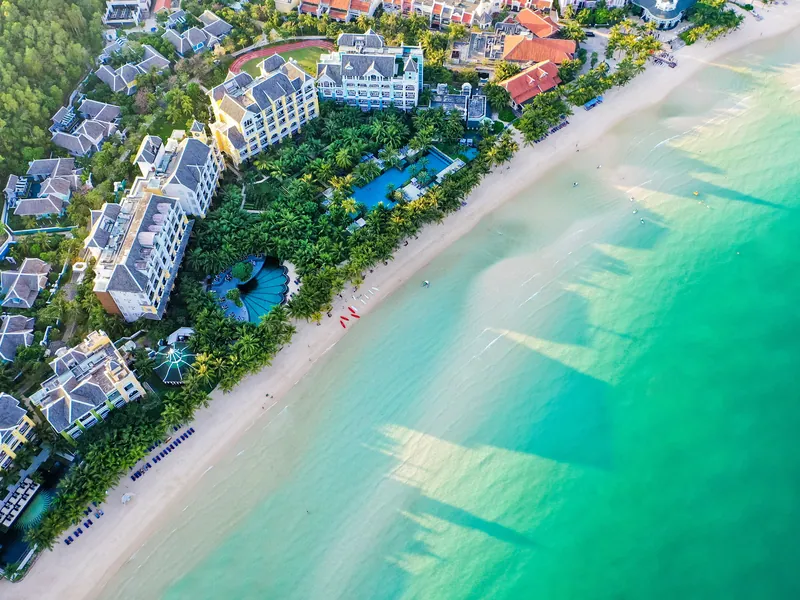 Bãi Trường / Long BeachMid-range
Long Beach — family resorts on the west-coast strip
The densest run of resorts built for families on the island: pools with shallow sections, kids' facilities, calm shelving water in the dry season, sunsets from the beach, and the shortest transfers to the airport and the town.
- Multiple pools, usually with a children's section
- Direct access to a long, gently shelving beach
- Fifteen to thirty minutes from the airport
- Restaurants and shops within walking distance of most resorts
Fitting a family in
Family suites and interconnecting rooms are standard here rather than a premium, and two-bedroom units are common. Check the stated maximum occupancy — some suites are priced for two adults and two small children only.
Watch out. This is where the island's construction is concentrated, so a neighbouring plot can be a building site with no warning — recent guest photographs are more reliable than a brochure. The strip is also the busiest part of the coast and hawker traffic on the public sections of beach is persistent.
Check hotel prices — opens Klook in a new tab (affiliate link)Live availability for your dates
Some links on this page are affiliate links. If you book through one, the price is the same for you and we may earn a commission. How this works.
Top family attractions in Vietnam
What each one costs, how long it takes, which ages it suits and whether you need to book ahead.
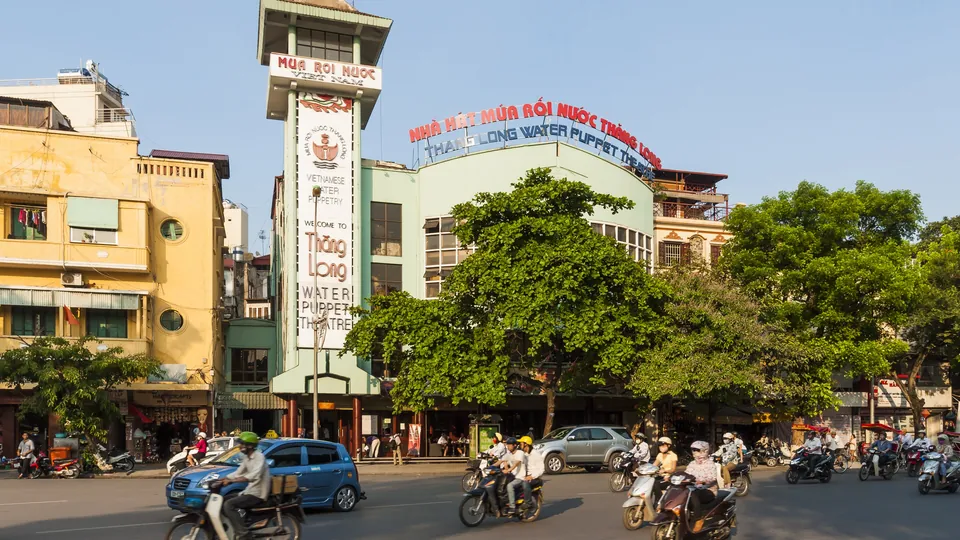 CultureBook ahead
Thăng Long Water Puppet Theatre
Hanoi
Wooden puppets worked from behind a screen across a waist-deep pool, staging village folk tales to a live traditional orchestra. Performances are short and run several times a day.
- Ages
- 3–12
- Time
- 1h
- Adult, from
- €5
Good to know. The show runs roughly fifty minutes with narration and songs in Vietnamese, so the appeal is visual — older children lose interest sooner than younger ones. The theatre is small and the front rows catch spray from the pool.
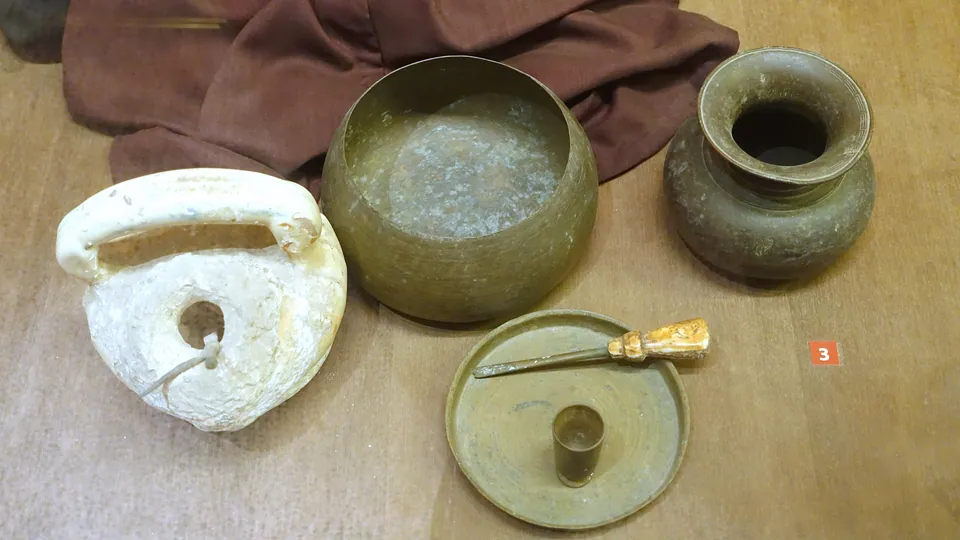 Museum
Vietnam Museum of Ethnology
Hanoi
Indoor galleries on Vietnam's ethnic groups plus an outdoor park of full-size traditional houses — stilt houses, a longhouse and a communal hall — that visitors can climb the ladders into.
- Ages
- 4–14
- Time
- 2h 30m
- Adult, from
- €2
Good to know. It sits around seven kilometres west of the old quarter, a twenty-five to thirty-five minute taxi depending on traffic. The outdoor section is the part children want and has very little shade, so it is a morning visit rather than an afternoon one.
 Nature
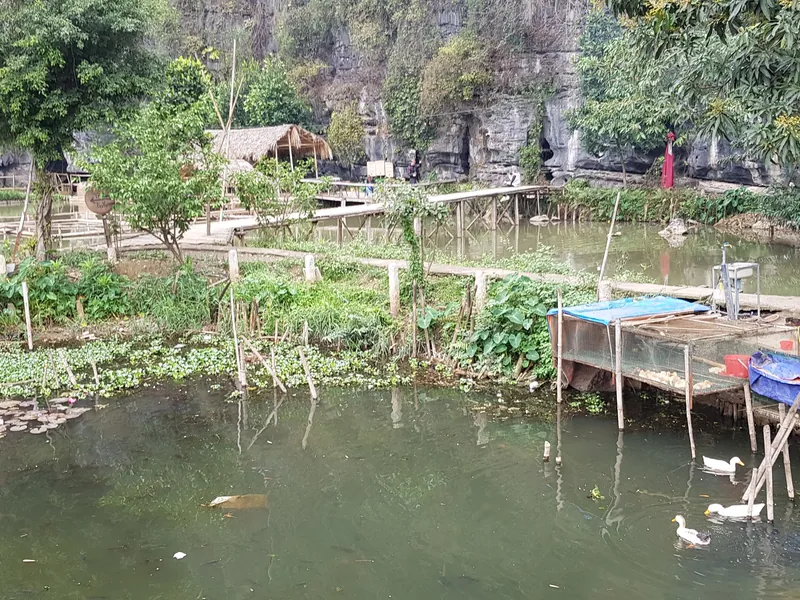
Tràng An boat route
Ninh Bình
A hand-rowed boat trip through a UNESCO-listed karst landscape, threading flat green channels between limestone towers and passing through a series of caves cut through the hills. The pier sells several numbered routes of different lengths.
- Ages
- 5–16
- Time
- 3h
- Adult, from
- €10
Good to know. Routes run from about two hours to three and a half, seated throughout on a low bench in a narrow boat with no shade over the open stretches and no way to get out partway. Several cave passages have ceilings low enough that everyone has to duck, and life jackets are supplied but rarely in small sizes.
 Adventure
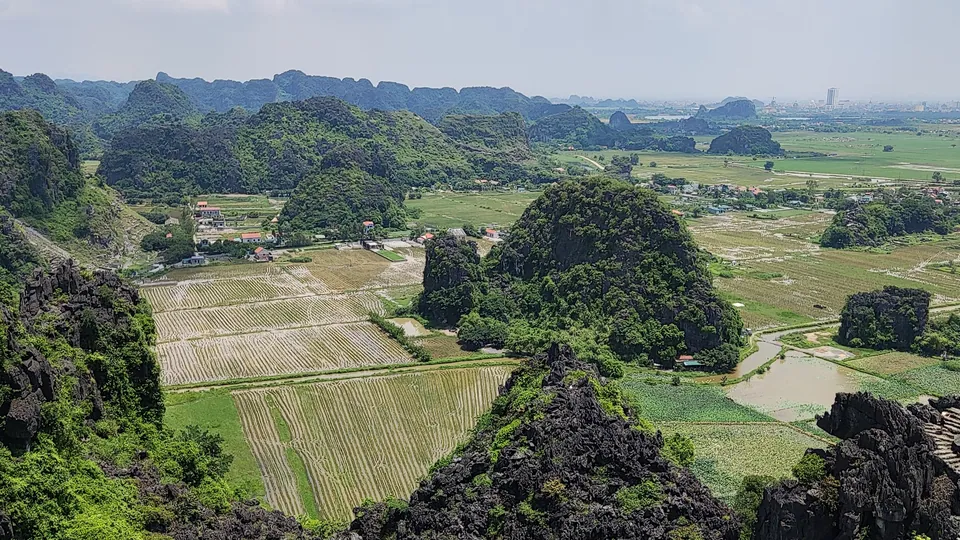
Hang Múa viewpoint
Ninh Bình
A stone staircase up a limestone outcrop to a small pagoda and a dragon sculpture, with the standard view over the Tam Cốc valley and its river bends from the top.
- Ages
- 8–16
- Time
- 1h 30m
- Adult, from
- €5
Good to know. Roughly five hundred uneven stone steps, steep and narrow in places, with exposed edges near the summit and almost no shade on the way up. Not a climb for a small child, a carrier or the middle of a hot day — go at opening or in the last hour of light.
 Culture
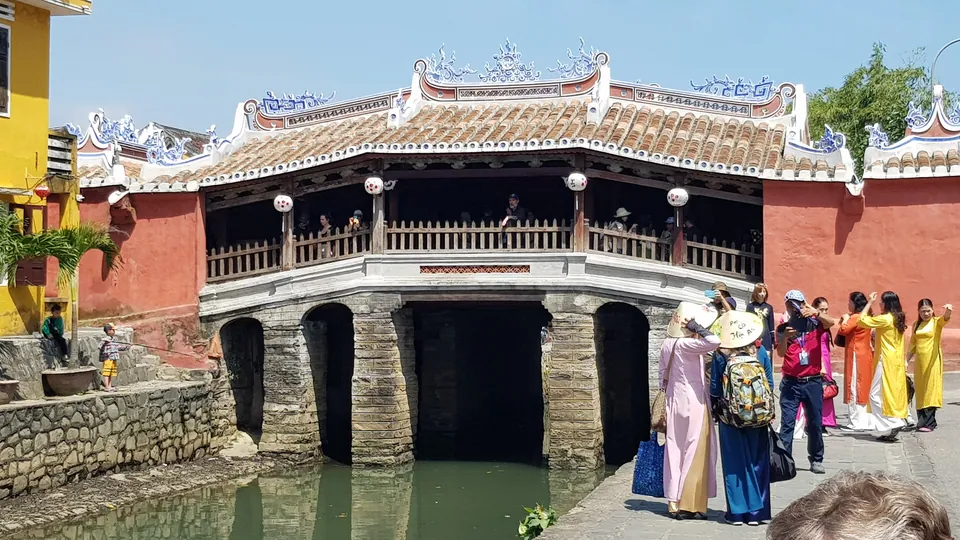
Hội An Ancient Town
Hội An
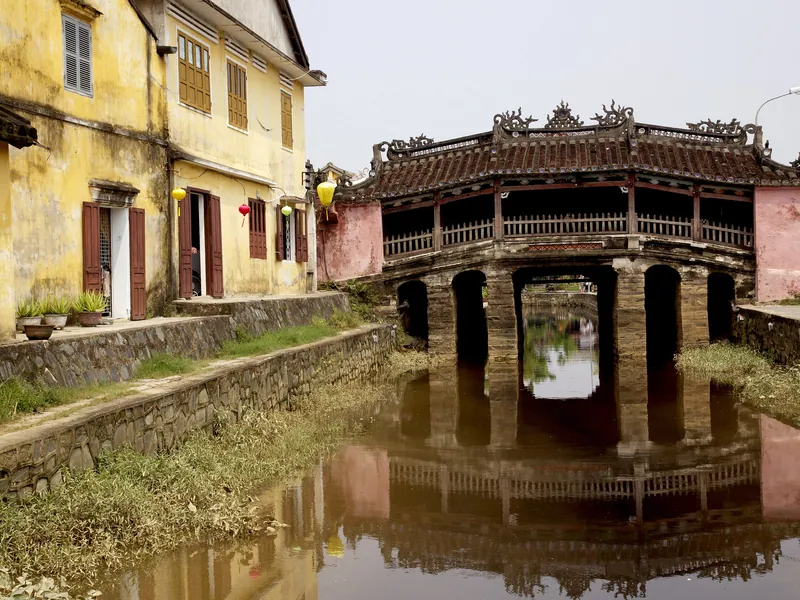
A preserved south-east Asian trading port of merchant houses, assembly halls, a Japanese covered bridge and a riverfront, hung with paper lanterns that are lit after dark. A single ticket covers entry to a set number of heritage buildings.
- Ages
- 4–16
- Time
- 3h
- Adult, from
- €5
Good to know. The ticket is sold at street booths and checked at each heritage house, and it does not cover simply walking the lanes. From about six in the evening the streets are shoulder to shoulder, and the riverbank and boat steps are unfenced, which needs a hand on a young child exactly when the crowd is thickest.
 FoodBook ahead
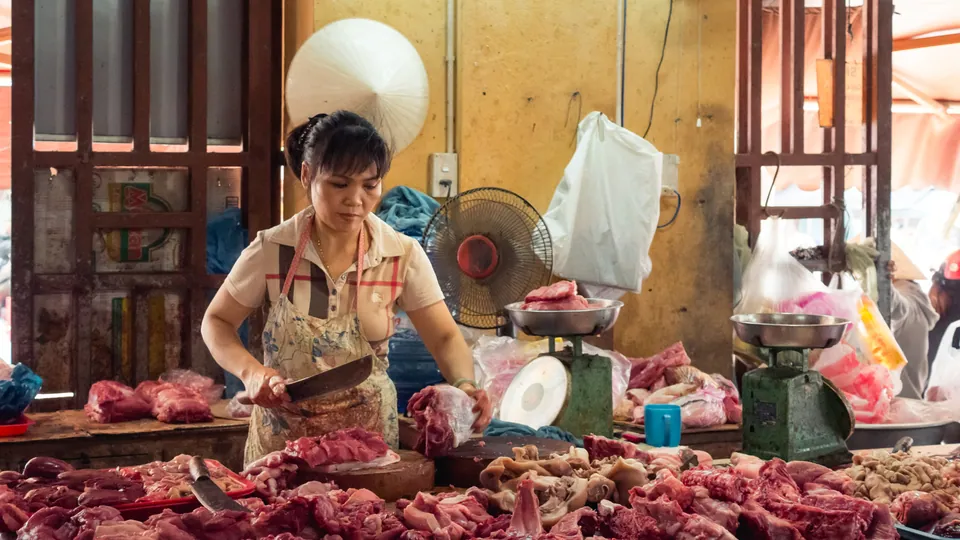
Hội An cooking class and market visit
Hội An
Half-day classes that start with a guided walk through the central market, often add a short boat or bicycle leg out to a garden kitchen, and finish by cooking and eating three or four Vietnamese dishes.
- Ages
- 6–16
- Time
- 4h
- Adult, from
- €30
Good to know. Most classes run about four hours, which is long for a child under six. Prices and formats vary widely, so confirm whether children get their own station at a reduced rate or simply sit and watch, and ask how the cooking is done — some kitchens use open gas burners at adult bench height.
 Water
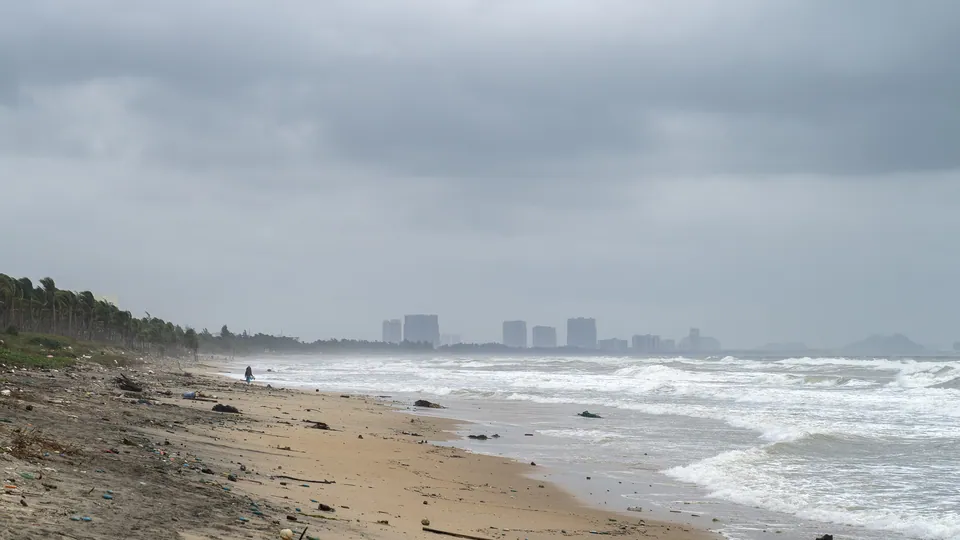
An Bàng beach
Hội An
The main beach for Hội An, four to five kilometres from the old town on flat roads, with a strip of restaurants and beach bars behind the sand and loungers for hire.
- Ages
- 0–16
- Time
- 4h
- Adult, from
- Free
Good to know. The sea has a shore break and rip currents outside the calm months and lifeguard cover is not continuous, so this is a beach for staying in the shallows with children. Erosion has reshaped this coast — the neighbouring Cửa Đại beach has lost most of its sand and carries visible sea defences, and An Bàng narrows in places.
 Adventure
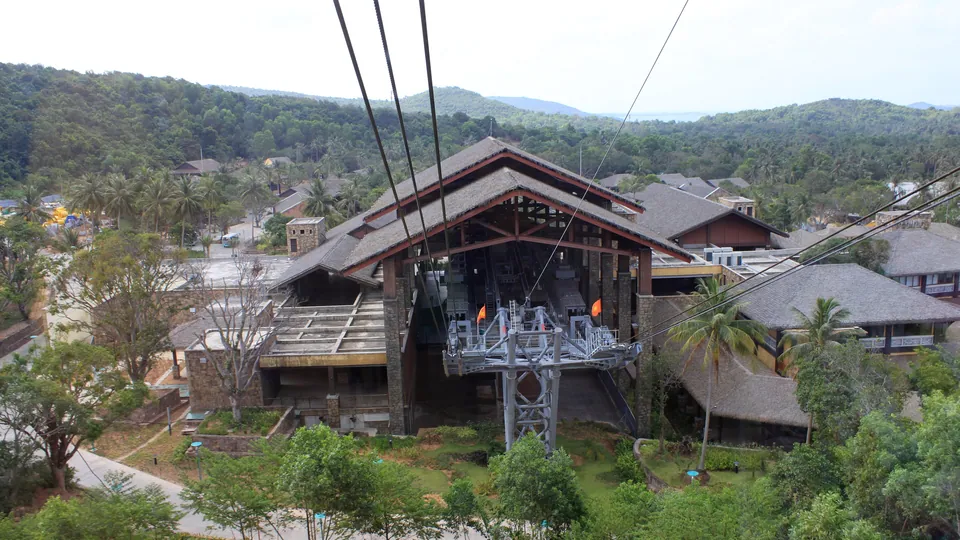
Hòn Thơm cable car
Phú Quốc
One of the longest over-water cable cars in the world, running roughly eight kilometres from the island's southern tip across a strait dotted with fishing villages to Hòn Thơm island, where the far terminal adjoins a beach and water park.
- Ages
- 4–16
- Time
- 2h 30m
- Adult, from
- €20
Good to know. The crossing takes about fifteen minutes each way in a glass-floored cabin high above open sea, which is genuinely difficult for anyone uneasy with heights and cannot be cut short. Service is suspended in high wind, and the ticket is normally sold bundled with the island park rather than as a ride on its own.
 Water
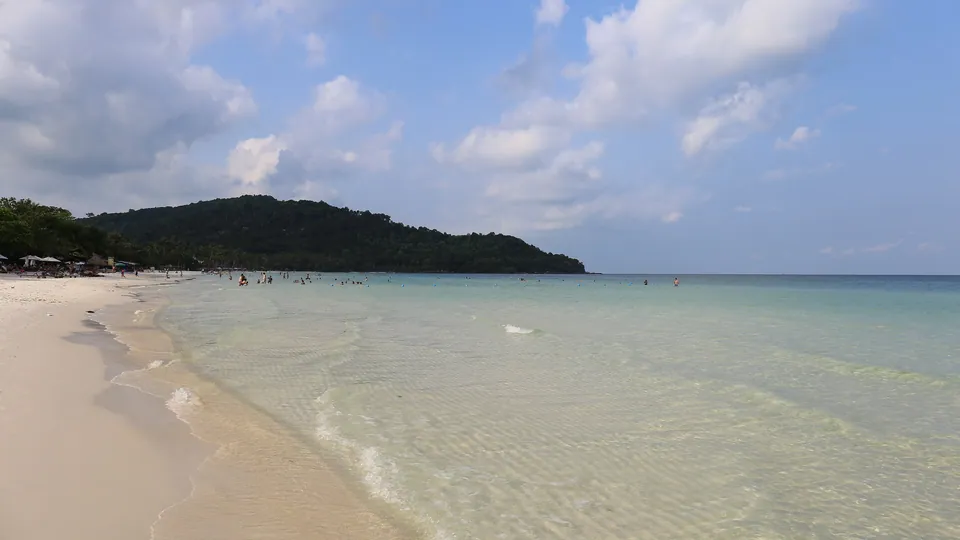
Bãi Sao beach
Phú Quốc
A curved bay of fine white sand on the island's southern end, with shallow, unusually calm water through the dry season and a line of beach clubs behind it.
- Ages
- 0–16
- Time
- 4h
- Adult, from
- Free
Good to know. It is around an hour by car from the main Long Beach resort strip, so it is a day out rather than a morning. Access to the sand is largely through beach clubs that charge for loungers, and onshore winds deposit washed-up litter that is cleared on some days and not others.
Some links on this page are affiliate links. If you book through one, the price is the same for you and we may earn a commission. How this works.
Getting around Vietnam
Domestic flights are the practical spine of a family route: Hanoi, Đà Nẵng, Ho Chi Minh City and Phú Quốc are all connected several times a day and fares are low. For anything under about three hours by road, a private car with a driver booked through the hotel costs a fraction of the European equivalent and removes the hardest part of a travel day. Sleeper trains on the Reunification line are comfortable and slow — Hanoi to Đà Nẵng is an overnight journey of roughly sixteen hours, which suits some families and defeats others. In the cities, ride-hailing apps cover taxis reliably and settle the fare before the car arrives; the motorbike option in the same apps is not for children. Child car seats are rarely available and should be assumed absent unless a transfer company confirms one in writing.
Do you need a rental car?
No car needed. Self-drive is not advisable for a visiting family. City and highway traffic is dominated by dense motorbike flow with very different right-of-way conventions, licensing for foreign drivers is a genuine complication that needs checking rather than assuming, and liability after even a minor collision is difficult to handle as a visitor. Private cars with a driver and short domestic flights cover every route in this guide at a cost that makes renting a car pointless.
What Vietnam costs with a family
Typical daily spend for a family of four, excluding flights. Accommodation, food, local transport and one paid activity a day.
€
€70
Budget · per day, family of four
€€
€140
Mid-range · per day, family of four
€€€
€290
Higher-end · per day, family of four
Planning estimates based on published prices at the time of writing, in shoulder season. Peak months, school holidays and city-centre accommodation all push the figure higher.
Food in Vietnam
One of the easier countries in Asia with fussy eaters. Phở and other noodle soups, rice with grilled pork, fried rice, fresh and fried spring rolls, bánh mì baguettes and cut tropical fruit are available on almost every street, and northern dishes are mild with chilli, lime and herbs added at the table. Central cooking around Hội An and Huế is noticeably spicier, so it is worth asking for dishes without chilli. Breakfast is savoury and soup-based, which surprises children expecting cereal — bakeries and hotel buffets fill that gap. Fish sauce is in nearly everything, including dishes that look vegetarian, so strict vegetarians should look for places advertising "chay" cooking.
Practical tips for Vietnam
The things that are easy to get wrong and expensive to fix once you have arrived.
When to go
Pick the region first, then the month
The north, centre and south are wet and dry at different times. A February trip is excellent in Hội An and Phú Quốc and merely acceptable in Hanoi; an October trip is lovely in Hanoi and the worst month of the year on the central coast. Decide which region matters most and let it choose the dates.
Getting around
Fly the long legs, drive the short ones
Domestic flights turn the three long north-to-south legs into an afternoon each. Keep the car for hops of two to three hours, such as Hanoi to Ninh Bình or Đà Nẵng airport to Hội An, where a private driver is cheaper than the flight would be and door to door.
Health & safety
Crossing the road is a technique, not a gap
Motorbike traffic flows around pedestrians rather than stopping for them. The method is to step off and walk at a slow, constant speed without stopping or running, holding small children on the upstream side. Waiting for a clear road in central Hanoi can take a very long time.
Health & safety
Assume no car seat unless it is confirmed
Taxis, ride-hailing cars and most private transfers arrive without child seats. Families who want one generally have to bring it, or book with a transfer company that confirms the seat and the child's weight in advance.
When to go
Sort the visa well before departure
Most nationalities need a visa or an e-visa arranged before arrival, though some are exempt for short stays. Eligibility, validity and fees are changed from time to time, so check the official immigration portal rather than a travel blog, and check it again close to the trip.
Staying connected
Arrange data before landing
Ride-hailing apps and translated menus are the two things that make the cities easy, and both need data from the moment the family clears the airport. An eSIM activated before departure avoids a queue at arrivals with luggage and tired children.
Money & costs
Learn the dong notes before shopping
Amounts run into the hundreds of thousands and the 20,000 and 500,000 notes are similar in colour, which is where mistakes happen. Cards work in hotels and larger restaurants; street food, boat piers and market stalls are cash only.
Health & safety
Treat motion sickness as a planning constraint
Several of the best family activities are boat trips, and the mountain and coastal roads are winding. A child who reliably gets sick in a car or on water narrows the shortlist genuinely — plan the shorter boat routes, sit them mid-boat, and carry whatever normally works before setting off rather than after.
Some links on this page are affiliate links. If you book through one, the price is the same for you and we may earn a commission. How this works.
Vietnam with kids: common questions
When is the best time to visit Vietnam with kids?
There is no one answer, which is the most important thing to know when planning. February to April and November to December are the months when most of the country is workable at once. Otherwise the north is best from October to December, the central coast from February to August, and the southern islands from November to April.
Do you need a rental car in Vietnam?
No, and self-driving is not advisable with children. Dense motorbike traffic, unfamiliar right-of-way conventions and complicated licensing for visitors make it a poor trade. Private cars with a driver are inexpensive and cover every short leg; domestic flights cover the long ones.
How long should a family trip to Vietnam be?
Twelve to sixteen days. The country is about 1,700 km long, so a shorter trip means picking one region — Hanoi with Ninh Bình, or the central coast, or the south — rather than trying to string them together.
What age works best for Vietnam?
From about five, when children can manage the flight, the heat and long days that include a two-hour boat trip or a market walk. Younger children travel perfectly well to a single beach base in the south; the multi-region routes suit school age upwards.
Is a visa required for Vietnam?
For most nationalities, yes — usually a visa or e-visa arranged before travel, with exemptions for some passports and short stays. The rules are revised periodically, so the official immigration site is the only source worth trusting for current eligibility and fees.
Is Vietnam safe for children?
Violent crime is rare and families are welcomed everywhere. The practical risks are road traffic, sun and stomach upsets: use bottled water, be careful with ice and uncooked salads outside established restaurants, and treat every road crossing as the day's main hazard. Comprehensive travel insurance with medical evacuation cover is sensible, as the best hospitals are concentrated in the largest cities.
Other destinations to compare
Every guide answers the same questions in the same order, so two countries take five minutes to compare rather than five evenings.
- Japan with Kids: Itineraries, Where to Stay & When to GoCulture, nature & adventure
- Italy with Kids: Itineraries, Where to Stay & When to GoMountains, lakes & cities
- Austria with Kids: Itineraries, Where to Stay & When to GoAlps, lakes & charming towns
- Cyprus with Kids: Itineraries, Where to Stay & When to GoSun, sea & family resorts