Skip to content

16 picks in Spain

Where to stay with kids in Spain

We list areas and property types rather than single hotels: family-room availability changes constantly, and the area plus the room requirement is what survives contact with a booking engine.
Spain with Kids: Where to Stay, Costs & When to Go

Family hotel picks in Spain

  • Apartment in the Eixample grid
    EixampleMid-range

    Apartment in the Eixample grid

    Two-bedroom apartments in the nineteenth-century grid cost less than two hotel rooms and add a kitchen, a washing machine and a living room to sit in once the children are asleep — which is what makes a five-night city stay sustainable rather than cramped.

    • Kitchen and washing machine
    • Metro within five minutes on foot
    • Walking distance to the main Gaudí houses and the old town
    • Wide, flat, pushchair-friendly pavements
    • Supermarkets and bakeries on every block

    Fitting a family in

    Two-bedroom units routinely sleep four to five without a rollaway. Original flats in this district are large by European standards, often with a long corridor and two street-facing rooms.

    Watch out. Older blocks have a very small lift or none at all, which is a significant problem on a fourth floor with a pushchair — confirm both the floor and the lift before booking. Rooms facing Gran Via, Aragó or Balmes carry heavy traffic noise, so an interior-facing or courtyard bedroom is worth asking for. Licensed tourist apartments are legally required to display a registration number; listings without one are operating outside the rules and can be cancelled at short notice.

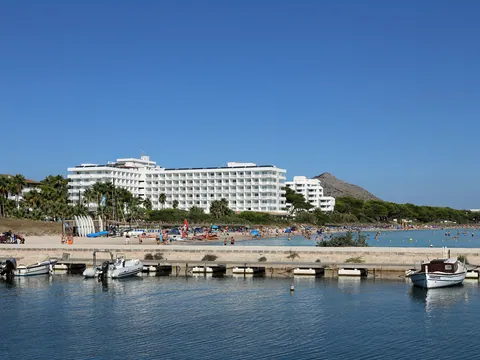
  • Seafront family rooms at Vila Olímpica
    Vila Olímpica / Port OlímpicHigher-end

    Seafront family rooms at Vila Olímpica

    Being on the beach side of the city removes the decision between sightseeing and swimming: the sand, a flat promenade, playgrounds and a marina are all downstairs, and the metro reaches the old town in about ten minutes.

    • Direct access to the beach and the seafront promenade
    • Flat, wide promenade suitable for pushchairs and scooters
    • Outdoor pools at several properties in the district
    • Playgrounds and the Ciutadella park within walking distance

    Fitting a family in

    Modern blocks in this area are more likely than the old town to offer genuine connecting rooms or a room with a sofa bed for four, and lifts are standard rather than a gamble.

    Watch out. Rates here are the highest in the city in July and August and the area has a nightlife strip around the marina that is loud until very late at weekends. It is also a district built in 1992 for the Olympics rather than an old neighbourhood, so the evening choice of restaurants is thinner and more tourist-priced than in Gràcia or El Born.

  • Beachfront family resort behind Platja de Muro
    Platja de Muro / Bay of AlcúdiaMid-range

    Beachfront family resort behind Platja de Muro

    This stretch of the Bay of Alcúdia is the most reliably suitable family beach on the island — several kilometres of fine sand that shelves very gradually — and the hotels directly behind it were built for families rather than adapted for them.

    • Direct or near-direct access to a shallow, lifeguarded beach
    • Children's pools and shallow splash areas as standard
    • Half-board and all-inclusive boards widely available
    • Flat terrain and a level promenade for pushchairs
    • Cycle hire and a flat coastal cycle path

    Fitting a family in

    Family rooms and two-room suites sleeping four to five are the standard product in this area rather than an exception, and apartment-style units with a kitchenette are common.

    Watch out. This is a purpose-built resort strip: it delivers convenience and very little local character, and the nearest working town is a drive or a bus ride away. Many properties close entirely from roughly November to April, and prices in August can be double those of June or September. Some hotels sit on the far side of the coast road rather than on the sand, which is a meaningful difference with a toddler.

  • Agroturismo finca in the Sóller valley
    Sóller / Serra de TramuntanaHigher-end

    Agroturismo finca in the Sóller valley

    A converted farmhouse in the orange groves gives space, a pool and quiet at the price of a resort room, and it puts the mountain railway, the tram to the port and the Tramuntana walking routes within a few minutes rather than an hour's drive.

    • Grounds and a pool rather than a shared resort complex
    • Breakfast usually included and made on site
    • Close to the Sóller railway, tram and port beach
    • Cool valley nights compared with the coastal resorts

    Fitting a family in

    Fincas typically have a small number of rooms, some of them family-sized or interconnecting, and several rent as a whole house — which can be the cheaper option for two families travelling together.

    Watch out. Access is usually by a narrow, unlit, winding lane, so a hire car and confident driving are effectively required and arriving after dark is unpleasant. There is no beach within walking distance, pools at smaller fincas are often unheated and unfenced, and some properties set a minimum age or a minimum stay in high season.

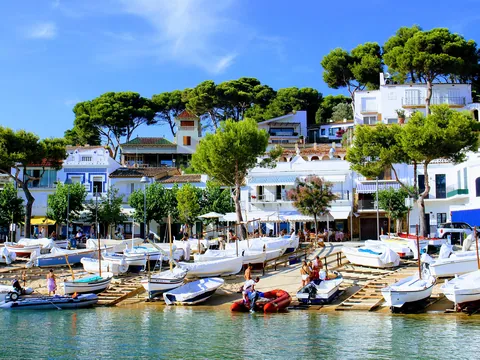
  • Apartment above Llafranc bay
    Llafranc / Calella de PalafrugellMid-range

    Apartment above Llafranc bay

    Staying in one of the linked cove villages means the coast path replaces the car for most of the week: two beaches, a lighthouse headland and a handful of restaurants are all reachable on foot, which removes the daily parking problem that defines this coast.

    • Walking distance to two or three coves via the Camí de Ronda
    • Kitchen for the early suppers that the Spanish dinner clock makes necessary
    • Sheltered, calm bay with lifeguards in season
    • Small seafront promenade rather than a resort strip

    Fitting a family in

    Two-bedroom holiday apartments are the standard local product, usually with a terrace and sleeping four to six. Many are let Saturday to Saturday in July and August.

    Watch out. The village is built on a slope, so an apartment with a sea view almost always means a steep climb back from the beach, often up steps. Parking is scarce and frequently paid, the bay is small and completely full in August, and the choice of restaurants shrinks sharply outside the summer season. Air conditioning is not universal in older blocks.

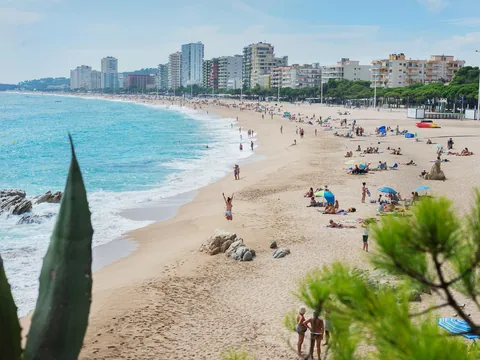
  • Aparthotel on the Platja d'Aro seafront
    Platja d'AroMid-range

    Aparthotel on the Platja d'Aro seafront

    For families who want a long flat beach, a pushchair-friendly promenade and a supermarket rather than a picturesque cove, this is the practical end of the coast — and the aparthotel format combines a kitchen with a pool and a reception desk.

    • Two kilometres of continuous sandy beach with a level promenade
    • Kitchenette plus hotel pool and cleaning
    • Supermarkets, pharmacies and a water park nearby
    • Bus links along the coast and to Girona

    Fitting a family in

    One and two-bedroom apartments sleeping four to six, with a sofa bed in the living area as the usual configuration for the fourth and fifth person.

    Watch out. Platja d'Aro is the most developed town on the central Costa Brava, with a main street of bars that is loud well into the night in August — a road-facing balcony is a mistake here. The beach is exposed and gets a real shore break in wind, and the town has more concrete than character compared with the villages 20 minutes north.

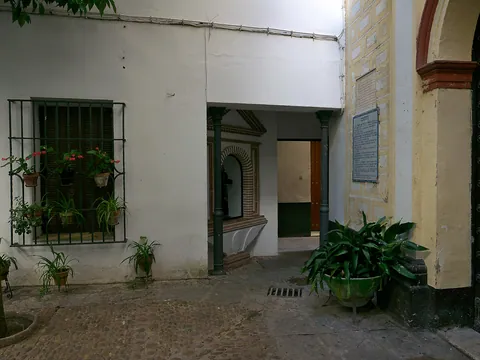
  • Patio house in Barrio Santa Cruz
    Barrio Santa CruzMid-range

    Patio house in Barrio Santa Cruz

    A traditional courtyard house puts the family inside the old quarter, a few minutes on foot from the Alcázar and the cathedral, and the central patio is a genuinely practical feature rather than a decorative one — it stays cool and gives children somewhere enclosed to be in the afternoon.

    • Two to five minutes' walk from the Alcázar and the cathedral
    • Shaded central patio that stays cool through the afternoon
    • Whole-house and multi-room lets sleeping a family in one booking
    • No transport needed for any of the main sights

    Fitting a family in

    Converted houses in this quarter let as whole properties or as a handful of rooms around the patio, so a family of four or five can usually be accommodated without splitting across floors of a hotel.

    Watch out. The lanes are too narrow for a taxi or a car to reach most doors, which means carrying luggage the last few hundred metres over cobbles. Sound echoes badly around an open patio, so one late group affects the whole house. Lifts are rare in buildings of this age and air conditioning should be confirmed explicitly rather than assumed — from June to September it is not optional here.

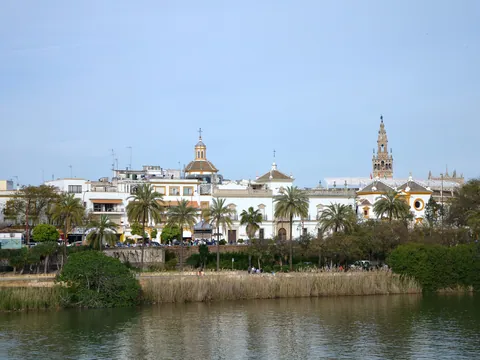
  • Hotel with a rooftop pool near El Arenal
    El Arenal / CentroHigher-end

    Hotel with a rooftop pool near El Arenal

    In a city where the afternoon is unusable outdoors for four months of the year, a pool changes the structure of the day: sights in the morning, the roof from two until six, the city again in the evening. El Arenal keeps that within a ten-minute walk of the cathedral.

    • Rooftop or courtyard pool for the afternoon heat break
    • Ten minutes on foot to the cathedral, the Alcázar and the river
    • Lifts, reliable air conditioning and a reception desk
    • Vehicle access to the door, unlike most of Santa Cruz

    Fitting a family in

    Triple rooms and connecting doubles are the usual way to sleep four here; genuine four-person rooms exist but are limited, so booking early matters more than in a coastal resort.

    Watch out. Rooftop pools in Seville are typically small plunge pools shared by the whole hotel, open only in the warm months and sometimes restricted by age or by session — worth confirming in writing rather than inferring from a photograph. The district is also quieter and more commercial in the evening than Santa Cruz or Triana, and prices spike hard around Holy Week and the April fair.

  • All-inclusive resort on the Costa Adeje seafront
    Costa AdejeMid-range

    All-inclusive resort on the Costa Adeje seafront

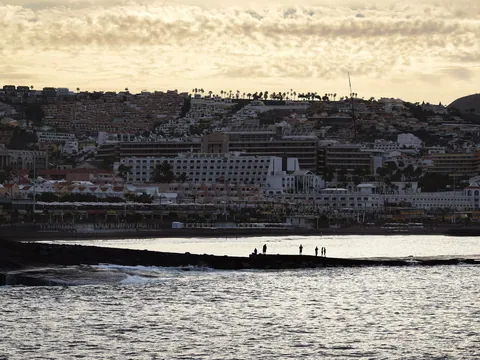
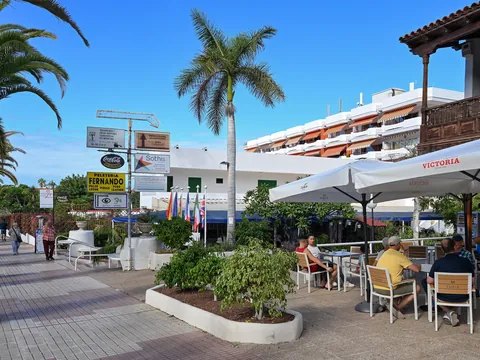
    The southern resorts exist because this is where the sun is most reliable and the sea is most sheltered, and a seafront all-inclusive removes the two hardest parts of a winter family week: finding safe swimming and feeding four people on a Spanish dinner clock.

    • Sheltered beaches behind breakwaters rather than open Atlantic swell
    • Heated pools, which matter between November and March
    • Children's clubs and buffets serving at European mealtimes
    • Long level promenade linking the resorts on foot

    Fitting a family in

    Family rooms, junior suites and two-room apartments sleeping four to five are the standard product in this area, and many complexes are apartment-style with a kitchenette as well as a board basis.

    Watch out. Costa Adeje is entirely purpose-built and dense, so there is no local town character within walking distance. Many complexes are terraced up a steep hillside, which means a long climb back from the beach and a genuine problem with a pushchair — sea-level or promenade-level properties cost more for that reason. Confirm the pool is heated rather than assuming it, and note that afternoon wind off the Atlantic is normal here even on hot days.

  • Apartment in Puerto de la Cruz
    Puerto de la Cruz / north coastBudget

    Apartment in Puerto de la Cruz

    The north coast costs noticeably less than the south and offers a real town rather than a resort: a seafront of botanical gardens, a seawater pool complex and neighbourhood restaurants, with the green Orotava valley and the laurel forest behind it.

    • Substantially cheaper than the southern resorts
    • Seawater pool complex as an alternative to the open sea
    • Walkable town with markets, playgrounds and local restaurants
    • Close to the botanical gardens and the Orotava valley

    Fitting a family in

    Older apartment blocks along the seafront let one and two-bedroom units with kitchens and balconies, typically sleeping four, at rates well below an equivalent southern resort.

    Watch out. The north is measurably cloudier and wetter than the south, and the beaches face open Atlantic swell — the black-sand bays are frequently flagged unsafe for young swimmers, which is why the town built the seawater pools. Much of the accommodation dates from the 1970s and 1980s and varies enormously in upkeep, and a car is more necessary here than in the south because the resort-to-attraction bus links are weaker.

  • Beachfront family hotel or aparthotel at Benalmádena
    Benalmádena Costa / TorremolinosMid-range

    Beachfront family hotel or aparthotel at Benalmádena

    This is the stretch the coast was developed for: half-board and all-inclusive hotels with children's pools directly behind a shallow patrolled beach, a level promenade running for kilometres in both directions, and a train station that reaches Málaga and the airport in under half an hour.

    • Children's pools and shallow splash areas as standard
    • Half-board and all-inclusive boards serving at European mealtimes
    • Level seafront promenade for pushchairs and scooters
    • Cercanías train to Málaga, the airport and Fuengirola
    • Water parks, a marina and a cable car within a short bus ride

    Fitting a family in

    Family rooms, two-room suites and aparthotel units with a kitchenette sleeping four to five are the standard product here rather than an exception.

    Watch out. Much of the accommodation dates from the 1970s and 1980s and has been refurbished to wildly varying standards, so the age of the building and the date of its last refit matter more than the published category. Many hotels sit on the inland side of the coast road or well above the promenade, which means a walk or a lift down to the sand; the beaches are dark, coarse sand rather than fine; and the bar strips behind Benalmádena Costa and central Torremolinos are loud until late in August.

  • Apartment in Málaga's old centre
    Centro histórico / Soho, MálagaMid-range

    Apartment in Málaga's old centre

    A centre apartment turns the eastern end of the coast into a city break with a beach attached: the museums, the market, the Alcazaba and the pedestrianised streets are all on foot, La Malagueta beach is a fifteen-minute walk, and the airport and the resorts are on the train.

    • Pedestrianised centre with the museums and the market on foot
    • Kitchen and washing machine for a longer stay
    • Cercanías train to the airport and the resort strip
    • City beach and the port promenade within walking distance

    Fitting a family in

    Two-bedroom apartments in converted centre buildings sleep four to five and cost less than two hotel rooms, usually on one floor with a small balcony.

    Watch out. Almost nothing in the centre has a pool, which is a real gap in July and August. Older buildings often have a very small lift or none at all, the pedestrian lanes carry restaurant terraces that are noisy until well after midnight — an interior-facing bedroom is worth asking for — and the centre sits inside a restricted-traffic and low-emission zone that a hire car cannot drive into.

  • Apartment or aparthotel in Nerja
    Nerja / MaroMid-range

    Apartment or aparthotel in Nerja

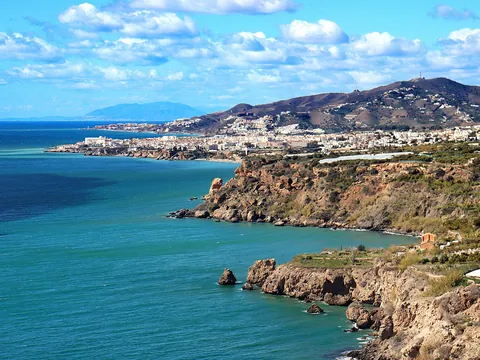
    Nerja is the quiet end of the coast: a small clifftop town about an hour east of Málaga with coves instead of a resort strip, restaurants that price for residents as well as visitors, and mountains immediately behind it for a day out of the sun.

    • Small sheltered coves rather than a continuous resort beach
    • Walkable town with a market, supermarkets and playgrounds
    • The Nerja caves and the Maro cliffs nature reserve nearby
    • Kitchen for early suppers and beach picnics

    Fitting a family in

    One- and two-bedroom apartments with a terrace are the standard local product, sleeping four to six, and many complexes have a shared pool.

    Watch out. Most of the coves are reached by long flights of steps down the cliff, which is a genuine problem with a pushchair or a tired four-year-old, and the one easy town beach gets very busy. There is no railway, so a car or the coastal bus is needed for anything beyond the town, and a good deal of the accommodation is older holiday apartments whose upkeep varies a great deal.

  • Apartment near Sol and Plaza Mayor
    Sol / Ópera / Plaza MayorMid-range

    Apartment near Sol and Plaza Mayor

    The dead centre puts the royal palace, the main squares, the market halls and three metro interchanges on foot, and an apartment adds a kitchen — which matters in a city where restaurant dinner starts at 20:30.

    • Every metro line within a few minutes on foot
    • Kitchen and washing machine for early suppers and laundry
    • Walking distance to the Royal Palace, the markets and the Prado
    • Supermarkets and bakeries open late

    Fitting a family in

    Two-bedroom apartments sleeping four to five are widely available in converted centre buildings and cost less than two hotel rooms.

    Watch out. This is the loudest part of Madrid — bars and street activity run past 02:00 at weekends, so a courtyard-facing bedroom is worth insisting on. Older blocks have a very small lift or none at all, the flats themselves are often narrow and dark, and air conditioning should be confirmed explicitly rather than assumed: from June to September it is not optional here.

  • Hotel family rooms by the Retiro and the museum boulevard
    Jerónimos / Paseo del PradoHigher-end

    Hotel family rooms by the Retiro and the museum boulevard

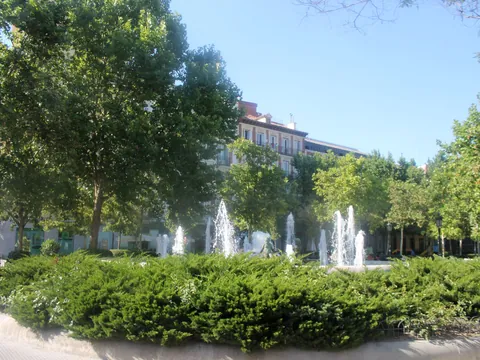
    The most comfortable base in a hot city: the park is across the road for an hour before the museums open, the Prado, Thyssen and Reina Sofía are all within a ten-minute walk, and the streets are wide, shaded and quiet at night.

    • The Retiro park and its playgrounds across the road
    • All three major museums within a ten-minute walk
    • Wide shaded pavements and quiet evenings
    • Lifts, reliable air conditioning and a reception desk

    Fitting a family in

    Triples and connecting doubles are the usual way to sleep four; genuine four-person rooms exist but are limited, so booking early matters more here than in a coastal resort.

    Watch out. The most expensive district in the city, and a museum and office quarter rather than a neighbourhood — the evening choice of restaurants is thinner and more formal than in Chamberí or La Latina, and a good deal of it closes on Sunday evening. Pools are rare and small where they exist at all.

  • Apartment in Chamberí or Argüelles
    Chamberí / ArgüellesMid-range

    Apartment in Chamberí or Argüelles

    A residential grid ten to fifteen minutes by metro from the museums, where the flats are larger and cheaper than in the centre and the streets have playgrounds, markets and neighbourhood restaurants that serve a little earlier than the tourist core.

    • Larger, quieter flats at lower rates than the centre
    • Playgrounds, markets and everyday shops on the doorstep
    • Metro to the museums in ten to fifteen minutes
    • Parque del Oeste and the Casa de Campo cable car nearby

    Fitting a family in

    Three- and four-room flats sleeping four to six are common here, frequently with two bathrooms, which is rare in the historic centre.

    Watch out. Every sightseeing day begins and ends with a metro ride, which is fine with school-age children and wearing with a toddler who still naps. There is little tourist infrastructure — no luggage storage and fewer late-opening shops — and older blocks vary a great deal in lift access and air conditioning.

How we make money

This page contains affiliate links. Booking through one costs you the same and may earn us a commission. It never changes what we recommend — every place is labelled either somewhere we actually stayed or something we researched but did not test. Read the full policy.