Skip to content

Alsace with Kids

Alsace is a narrow strip between the Rhine and the Vosges where the villages are half-timbered, flower-hung and small enough to walk around in half an hour, which suits children far better than a city of museums. Strasbourg anchors the north with a cathedral, a famous astronomical clock, boat trips and trams, and a chain of wine-route villages runs south from it to Colmar past hilltop castles and rooftop stork nests. The practical shape of a trip here is a city base plus driving days, because the villages sit five to fifteen minutes apart and buses barely serve them. Two honest warnings: Colmar's centre is tiny and overrun by day-trippers through the middle of the day, and the December Christmas markets — the region's best-known draw — are among the most crowded in Europe, with doubled room prices and streets that a pushchair cannot cross.

Best for ages
3+
Suggested stay
4–6 days
Best months
May–Sep, Dec
Daily budget
€220

Mid-range, family of four

Why Alsace works with children

  • Villages that look invented

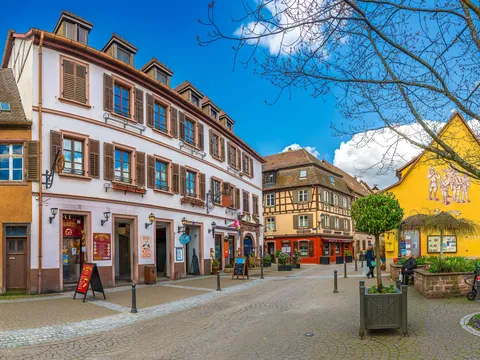
    Timber frames, painted shutters and cobbled squares, each village walkable in half an hour, which makes a village stop a short stop rather than a march.

  • Storks nest on the rooftops

    White storks were reintroduced across the region and now nest on church towers, chimneys and platforms from spring onwards, so children spot them from the street without a ticket or a hide.

  • An open-air village instead of a museum

    The Écomusée d'Alsace is a reconstructed working village of relocated houses with animals, craft workshops, boats and a carousel, and it fills a full day on its own.

  • Strasbourg runs on trams and flat cycle paths

    The city is level, compact and threaded with separated cycle tracks, and a tram network covers the rest, so the car can stay parked for the days spent in it.

  • Tarte flambée solves the meal-time problem

    Winstubs serve flammekueche — a thin, crisp, pizza-like tart — through the evening and often outside standard French service hours, which is a low-risk order with children.

Where to stay

Best areas in Alsace for families

4 areas cover most trips here; the difference is mainly a base with no car for part of the trip versus wet days and big collections.
  • Strasbourg — Grande Île & Krutenau

    Best for a base with no car for part of the trip

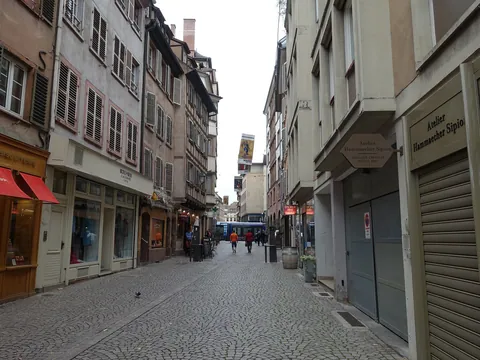
    The cathedral, the boat quay, the covered markets and the trams are all within walking distance, with a large park and its stork enclosures a short ride out. The Grande Île is cobbled throughout, and in December it is fenced and its entrances are checked, which means queues at the bridges.

  • Colmar & the southern wine route

    Best for the prettiest cluster of villages

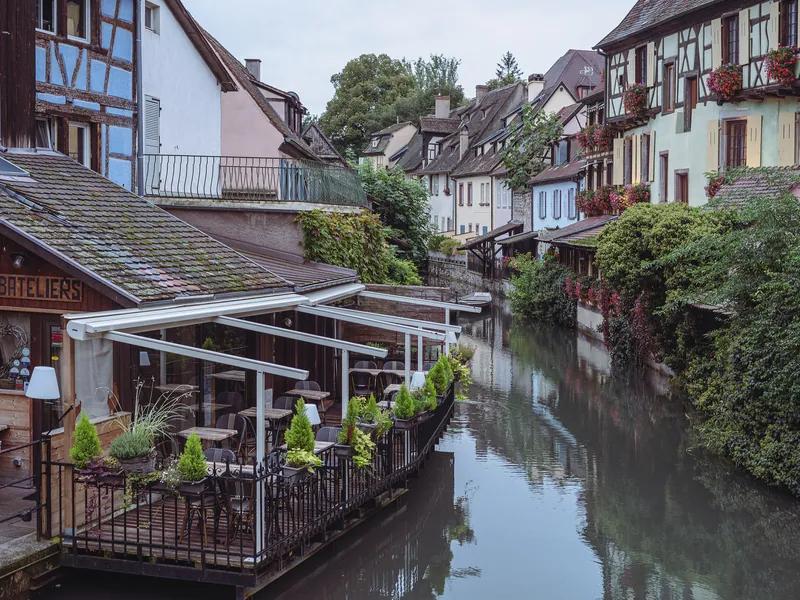
    Colmar's canal quarter and the villages around it — Eguisheim, Kaysersberg, Riquewihr — are the postcard Alsace and within fifteen minutes of each other. The centre is small, jammed between late morning and late afternoon, and its car parks sit on the edge of town.

  • Obernai, Barr & the northern wine route

    Best for value and a quieter base

    Market towns on the railway with rooms that sleep four at well below Colmar prices, and the big hilltop castle and the monastery on its cliff within half an hour. Less to look at in the evening, and fewer restaurants open outside weekends.

  • Mulhouse & the south

    Best for wet days and big collections

    The national railway and motor-vehicle collections and the open-air village museum all sit within a short radius, which is the region's insurance against rain. The city itself is functional rather than pretty and is an hour from Strasbourg.

Family hotel picks in Alsace

  • Apartment on Strasbourg's Grande Île or in Krutenau
    Grande Île / Krutenau / Petite France edgeMid-range

    Apartment on Strasbourg's Grande Île or in Krutenau

    A flat in the island centre or just across the water puts the cathedral, the boat quay, the covered market and the trams within walking distance, so the car can be left parked for the city days and collected only for the village drives.

    • Walk to the cathedral, the markets and the boat quay
    • Trams and separated cycle paths from the door
    • Kitchen and washing machine for a longer stay
    • Park with stork enclosures a short tram ride out

    Fitting a family in

    Two-bedroom flats sleeping four are the common unit; apartments in the oldest buildings are small and often split over two levels with low beams.

    Watch out. Many old-town buildings are walk-ups with steep narrow stairs and no lift, the Grande Île is cobbled throughout, and the Petite France lanes are packed from late morning. In December prices roughly double, rooms go months ahead, and the island's entrances are checked, which means queues at the bridges.

  • Gîte or winegrower's guest rooms on the wine route
    Ribeauvillé / Riquewihr / KaysersbergMid-range

    Gîte or winegrower's guest rooms on the wine route

    Sleeping in one of the villages is what buys the hours before the coaches arrive and after they leave, which is when these places are actually pleasant, and a courtyard or garden gives children somewhere to be between outings.

    • A village to walk around in the early morning and the evening
    • Courtyard or garden and a kitchen
    • Parking included, which the villages otherwise charge for
    • Bakery and a handful of restaurants within a few minutes

    Fitting a family in

    Converted outbuildings and upper floors typically sleep four to six across two bedrooms, often on two levels. Confirm cot and highchair availability rather than assuming it.

    Watch out. Old houses mean steep narrow stairs, low beams and no lift, there is nothing within walking distance beyond the village itself, and village restaurants close one or two full days a week and stop serving early. December stays in these villages are booked out and priced up well in advance.

  • Family rooms in Obernai, Sélestat or outer Colmar
    Obernai / Sélestat / Colmar outskirtsMid-range

    Family rooms in Obernai, Sélestat or outer Colmar

    Rooms that genuinely sleep four are far easier to find outside the two famous centres, they cost noticeably less, the wine route starts at the door and the regional train still reaches Strasbourg and Colmar in under half an hour.

    • Quad and connecting rooms more widely available than in the centres
    • Free or included parking rather than an edge-of-town car park
    • Regional trains to Strasbourg and Colmar
    • The hilltop castle and the wine-route villages within half an hour

    Fitting a family in

    Mid-sized hotels here list genuine four-person rooms and connecting doubles; check whether the fourth bed is a full bed or a pull-out before booking a week.

    Watch out. These are functional towns rather than postcard ones, so the evening is quieter and the restaurant choice is thinner, and the pretty centres are a short drive or train ride away. In December the bottleneck moves to the roads and car parks at the other end.

All family stays in France

Some links on this page are affiliate links. If you book through one, the price is the same for you and we may earn a commission. How this works.

Things to do in Alsace with kids

  • Strasbourg cathedral & its astronomical clock
    Culture

    Strasbourg cathedral & its astronomical clock

    Alsace

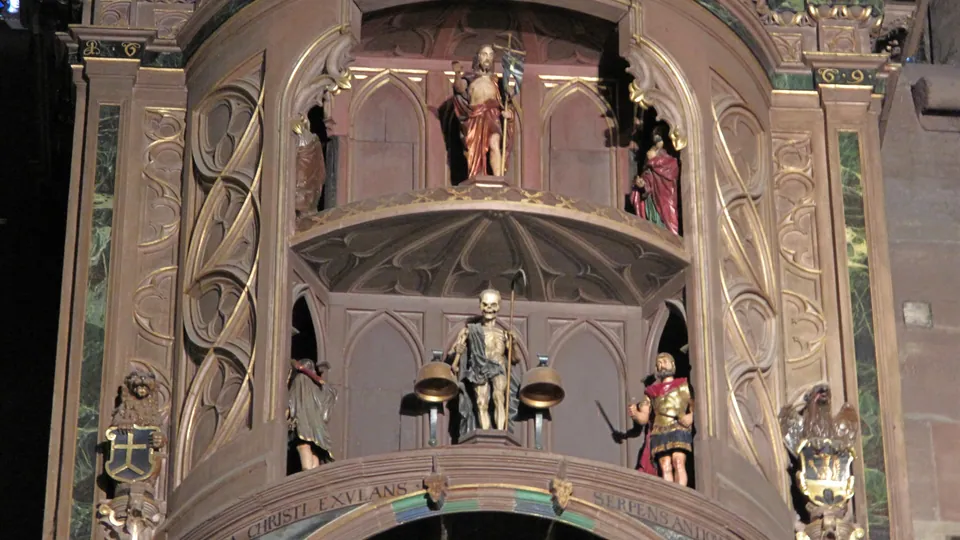
    A sandstone gothic cathedral in the middle of Strasbourg's island centre, holding a Renaissance astronomical clock whose figures move in a daily performance, with a tower platform reached on foot for a view over the city and the Rhine plain.

    Ages
    5–16
    Time
    2h
    Adult, from
    €5

    Good to know. The clock's figures perform once a day and the ticket is sold only for that showing, shortly beforehand, and it goes quickly in school holidays. The tower platform is a spiral staircase of over three hundred steps with no lift, and the nave is cold even in summer.

  • Écomusée d'Alsace
    Museum

    Écomusée d'Alsace

    Alsace

    An open-air museum built as a working Alsatian village from dozens of relocated timber-framed houses, with farm animals, craft workshops, horse-drawn carts, rowing boats and a period carousel spread across a large site in the south of the region.

    Ages
    3–14
    Time
    6h
    Adult, from
    €17

    Good to know. Almost all of it is outdoors, so a wet day is a wet day and there is little shelter between the houses. The site is large enough that a family walks several kilometres in a visit, and it closes for much of the winter apart from a Christmas season.

  • Château du Haut-Koenigsbourg
    Culture

    Château du Haut-Koenigsbourg

    Alsace

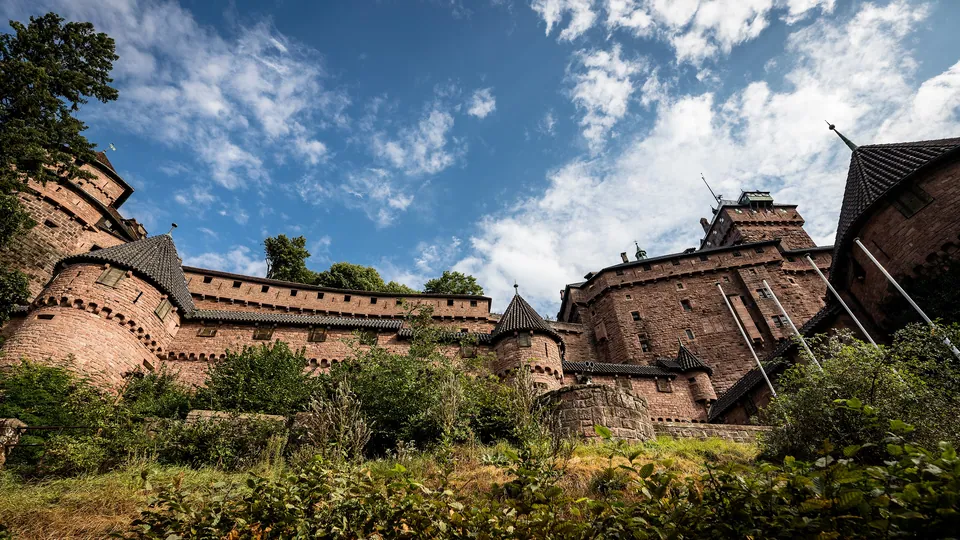
    A rebuilt hilltop castle above the plain near Sélestat, complete with drawbridge, keep, ramparts, a well and furnished halls, reached by a road of hairpins and a short climb from the car parks below the walls.

    Ages
    5–16
    Time
    2h 30m
    Adult, from
    €10

    Good to know. The approach from the car park is steep and the interior is cobbles, spiral staircases and ramparts with drops behind low parapets, so it needs watching with small children and is not a pushchair route. Car parks fill by mid-morning in summer, and low cloud can remove the view the castle is climbed for.

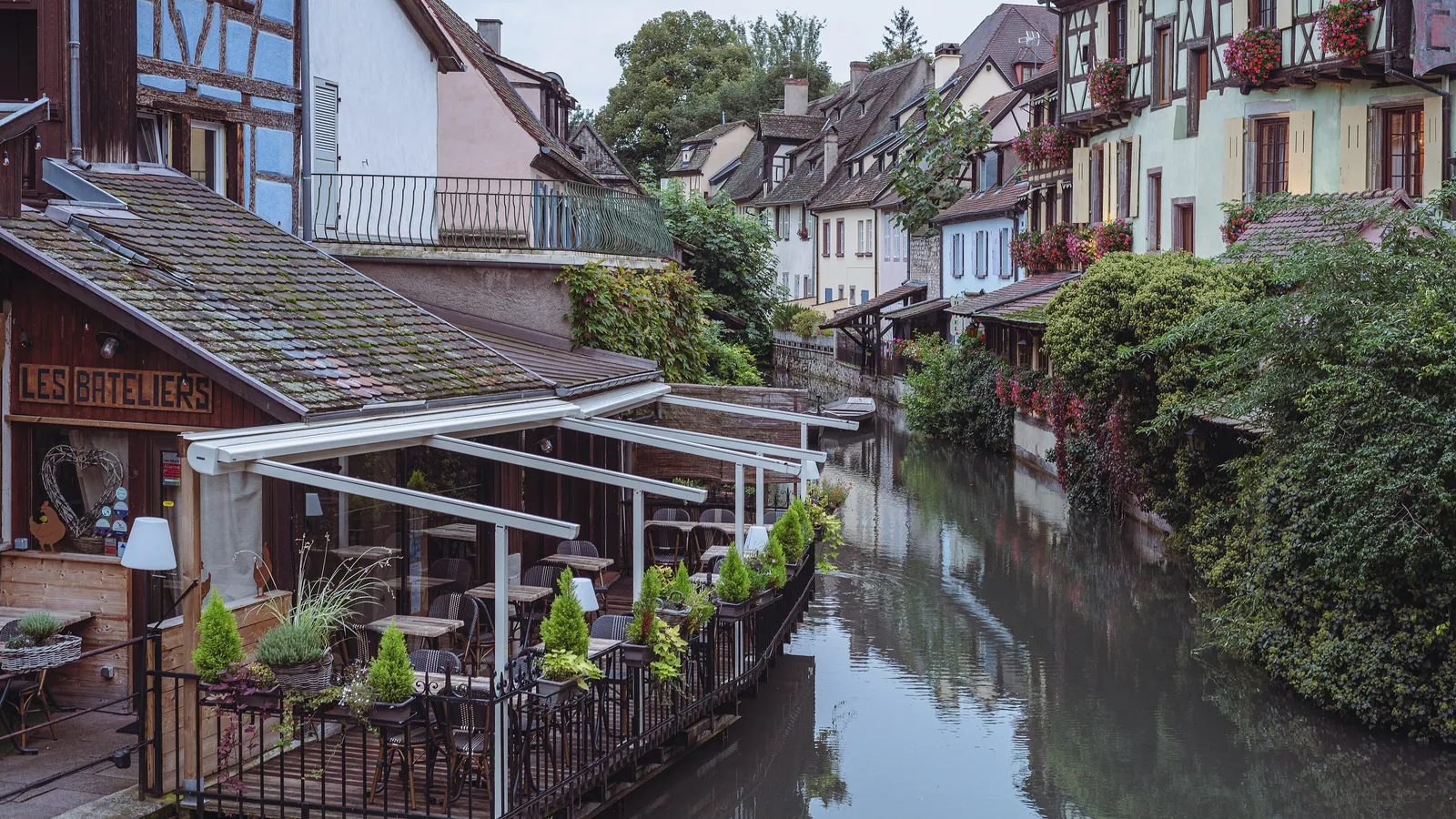
  • Half-timbered houses in strong colours along a narrow canal
    Animals

    Stork and otter park at Hunawihr

    Alsace

    A small park among the vineyards on the wine route, set up to reintroduce white storks to the region, with open stork enclosures, otters, penguins and a fishing demonstration, alongside a separate walk-through butterfly house nearby.

    Ages
    2–12
    Time
    2h 30m
    Adult, from
    €12

    Good to know. This is a two-hour stop rather than a day out, the enclosures are outdoors with little cover, and the animal demonstrations run to a fixed daily schedule that the visit has to be planned around. It closes over the winter, so it is not a Christmas-market addition.

Some links on this page are affiliate links. If you book through one, the price is the same for you and we may earn a commission. How this works.

Getting around Alsace

A TGV reaches Strasbourg from Paris in under two hours, and frequent regional trains run down the plain to Sélestat, Colmar and Mulhouse, so the cities and the museums are reachable without a car. The wine-route villages are the problem: they lie a few kilometres off the railway with sparse bus services, and a car or an organised day tour from Colmar is the realistic way to link them. Village centres are pedestrianised with paid car parks on the edge that fill by mid-morning in summer and on market days, and in December several of the market towns move visitors in from outlying car parks instead. Distances are short — the whole wine route is around 170 km — so drives are rarely more than twenty minutes.

Alsace tips for families

  • When to go

    The Christmas markets are far busier than the photographs

    Strasbourg and Colmar on a December weekend are shoulder-to-shoulder, room prices roughly double and the best-placed hotels sell out months ahead. A weekday, an early afternoon before the after-work crowd, or a smaller market town is the version that works with young children, and a pushchair is close to unusable in the busiest lanes.

  • Getting around

    Trains reach the cities, not the villages

    Strasbourg, Colmar and Mulhouse are easy by rail, but the wine-route villages have thin bus services and the walk between them follows roads rather than paths. A car for the village days, parked on the edge of each centre, is what makes the region work.

  • With kids

    Keep one indoor collection in reserve

    The Rhine plain gets genuine rain in any season, and the region's answer is its museum density — the railway and motor collections in the south are entirely indoors. The open-air village museum is the opposite: almost all of it is outside, so it is the wrong choice on a wet day.

  • Food

    Winstubs are more forgiving than French kitchens elsewhere

    Tarte flambée is cooked to order all evening and often outside the usual service windows, and pretzels and bakeries cover the afternoon gap. Even so, many village restaurants close one or two full days a week, which is worth checking before driving to one.

Alsace with kids: common questions

How many days does Alsace need with children?
Four to six. Four covers Strasbourg, a run of wine-route villages and one big outing such as the hilltop castle or the open-air village museum. Six allows Colmar, the southern villages and a museum day in the south without long drives.
Is Alsace worth visiting in December with kids?
For an afternoon and an evening, yes — the markets are genuinely atmospheric and the smaller towns are the pleasant ones. As the basis of a whole trip with young children it is hard: it is cold, dark early, crowded to the point where a pushchair is unusable, and roughly twice the price of the rest of the year.
Do you need a car in Alsace?
Not for Strasbourg, Colmar or Mulhouse, which are linked by frequent regional trains. A car is effectively required for the wine-route villages, the hilltop castles and the open-air museum, or a day tour from Colmar in its place.
Is Colmar worth staying in rather than visiting?
Staying overnight is what buys the early morning and the evening, which are the only hours the canal quarter is calm. The centre is small and largely pedestrianised, so a room there means parking on the edge and walking in with luggage.
What is there for children besides the villages?
A hilltop castle rebuilt complete with ramparts and a drawbridge, an open-air village museum with animals and craft workshops, a stork and otter park on the wine route, boat trips in Strasbourg, and the national railway and motor-vehicle collections in the south for a wet day.